


Why rivers behave differently from canals
A canal is a tame thing. It sits in a channel built by hand, fed by reservoirs and feeders, and its level barely shifts unless something has gone badly wrong. A river is the opposite: it is a living drainage system, and everything that falls on its catchment eventually comes past your bow. That is why a bright, still Saturday morning can still be a terrible day to take a narrowboat or a small cruiser onto a navigable river. The rain that matters may have fallen two days earlier, thirty miles upstream, on ground that was already sodden.
So before any river day trip, treat the forecast as only half the picture. The other half is what the river is doing right now — and what it is about to do.
Start with the rain that has already fallen
Look at rainfall over the whole catchment, not just at the town where you keep the boat. A useful habit is to check the totals for the last twenty-four and seventy-two hours across the upper reaches. If the ground is saturated, almost all of that water will run off rather than soak away, and the river will rise quickly. If it has been a dry fortnight, the same rainfall may barely register.
- Overnight rain upstream is the classic trap. You wake to sunshine, but the peak is already travelling towards you.
- Peaks take time. On a long river, high water can arrive a day or two after the storm, so the nicest weather sometimes coincides with the worst conditions.
- Check the gauge readings published by your navigation authority and compare them with the normal range for the time of year. A level that looks modest in February may be remarkable in August.
- Watch the trend, not just the number. A river falling steadily is far friendlier than one still climbing, even if the falling river is technically higher.
Reading the water in front of you
When you reach the boat, spend five minutes simply looking at the river. Colour tells you a lot: a peaty brown or a milky grey usually means plenty of freshly disturbed silt is on the move. Speed is the next clue. Watch a leaf or a stick. If the surface is travelling faster than a brisk walking pace, the river has real power in it, and your stopping distance in a lock cut or at a mooring will be far longer than usual.
- Debris — branches, fence posts, whole small trees — is the clearest warning of all. It damages hulls, fouls propellers, and jams lock gates.
- Standing waves, boils and swirling eddies below a weir or a bridge arch mean fast, turbulent water that can take a small boat sideways in seconds.
- A towpath under water sounds obvious, but it also means the bank is being scoured and mooring pins may not hold.
Navigation notices and lock closures
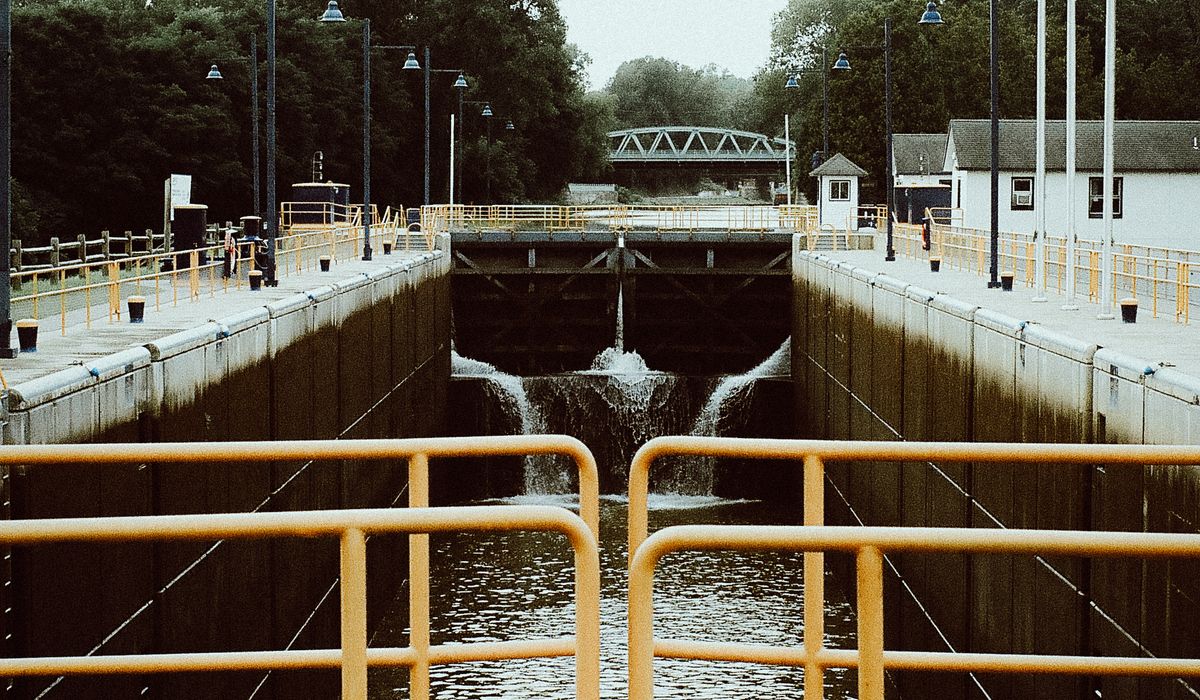
Navigation authorities publish notices and stoppages, and they are not optional reading. In high water, locks on many rivers are closed to navigation altogether, or placed on restricted working with strong streams running through the chamber. On some waterways the weir boards are drawn or the paddles set to pass the flood, and the lock may be left open at both ends for safety — never assume you can use it.
Some locks and bridges also carry headroom or draught restrictions in flood. That low arched bridge you passed under comfortably last month may have a metre less clearance today, and the water beneath it will be the fastest on the whole stretch. If you are unsure, ring the lock keeper or the harbour master before you cast off; they would far rather answer a question than attend an incident.
Bridges, weirs and the tricky bits
Two structures deserve special respect. The first is the weir. Its approach is often marked by booms, warning signs and a line of white water that is easy to misjudge from upstream. Stay well clear, and never attempt to turn or moor just above one. The second is the bridge. Arches squeeze the flow, so the current accelerates exactly where your steering is least effective, and rubbish collects against the piers.
Plan your line early, keep plenty of power in reserve, and give the arch with the strongest flow a wide berth. If a bridge looks doubtful, there is no shame in turning round and mooring for lunch instead.
A simple routine before you set off
- Check catchment rainfall for the past three days, and the forecast for the next two.
- Read the river level gauge and note whether it is rising, steady or falling.
- Scan the current navigation notices and stoppages for your stretch.
- Look at the water at the mooring: colour, speed, debris, headroom.
- Have a Plan B — an upper non-tidal stretch, or a canal arm that is unaffected by the flood.
- Carry life jackets, a throw line, warm spare clothing, and a means of calling for help.
None of this takes more than twenty minutes, and it is the difference between a relaxed day afloat and one you would rather forget. Rivers reward a little humility. Read them carefully, and they will give you some of the finest boating in Britain.


Leave a reply